
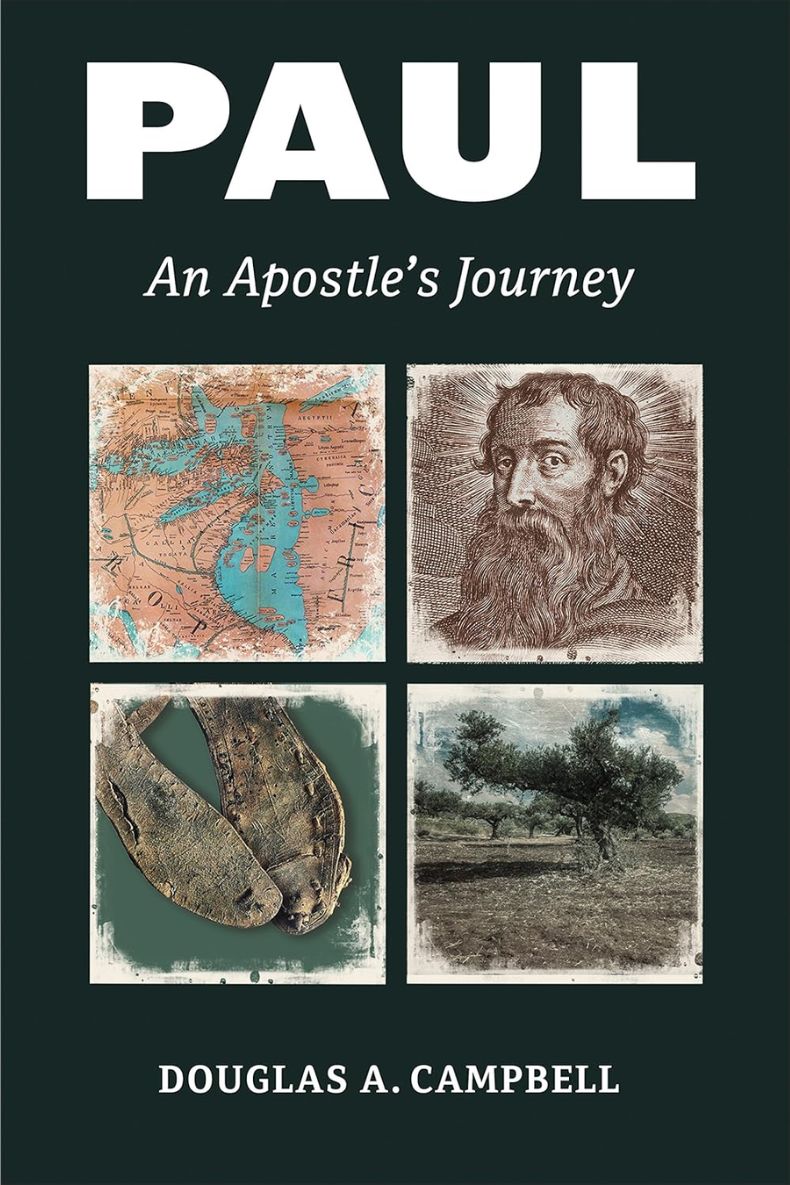
Paul: An Apostle’s Journey by Douglas A. Campbell. Grand Rapids: Eerdmans, 2018. xii + 207 pp. $22.00.
Douglas Campbell consistently produces some of the most provocative and thoughtful work on Paul in all of modern scholarship. He is a champion for an apocalyptic reading of Paul’s letters and one of the few experts on Pauline biography. As the field of Pauline scholarship becomes increasingly difficult to navigate, in Paul: An Apostle’s Journey he has now set his sights on presenting his understanding of Paul in an accessible, narrative format.
One of the most compelling aspects of this work is the biographical scholarship lying just beneath the surface. Campbell has written an entire volume on Pauline biography solely on the basis of Paul’s letters (Framing Paul) and this volume draws richly from that rigorous study to present the fruits of that study in narrative form. This same sort of phenomenon is also present in his presentation of Paul’s “Enemies.” A large part of Campbell’s reading of Paul depends on the identity of the enemies in Philippians 3, Galatians and Romans. Those seeking Campbell’s conclusions without the endless pages of arguments and footnotes will appreciate this volume.
Using data from Paul’s letters and from Acts, Campbell tells the story of Paul’s “conversion” (if not from Judaism, then to trinitarian Christianity), to Paul’s breakthrough concerning the mission to the Gentiles and Paul’s networking evangelism strategy. While these first three chapters are undergirded by rigorous scholarship and tell a historical story, the thrust is decidedly theological and practical. Through Paul’s story Campbell offers theological insights and advice to modern Christian communities.
At this point the story picks up with the letters of Paul in chronological order, the Thessalonian correspondence first. Over two chapters Campbell addresses the early date of these letters based on the events related to Emperor Gaius and his mission to set up his statue in the Jerusalem Temple. In this context he also tackles the topic of mission and defining the other. Paul teaches the Christian not to define others colonially for the purpose of changing them, but rather in terms of friendship, motivated by love. Furthermore, Campbell notes that as the members of the Trinity are defined by their relationships as Father and Son, likewise people are fundamentally relational. As such, matters of relationship dominate the discussion of the letters to the Thessalonians.
After briefly discussing the period of time for which no information about Paul is extant, Campbell picks up with the prison epistles: “Ephesians,” Colossians and Philemon. He draws on his previous biographical work to narrate the setting and situation of these letters, and that “Ephesians” is better regarded as the letter to the Laodiceans mentioned in Colossians. Uniquely, Campbell draws out the implications of Paul’s frequent imprisonments, advocating for more robust Christian ministry to those who are incarcerated. Furthermore, Campbell here tackles important Pauline motifs such as election and the role of the resurrected mind in the life of the believer.
The narrative then moves to the troubled community in Corinth. After cataloguing fifteen problems in the community and briefly walking through Paul’s answers, Campbell tackles the difficult issues of sex and gender. He demonstrates Paul’s views on divorce, sexual abstinence within marriage and blatant promiscuity, showing that incorrect theological reflection led the Corinthians to these practices. Campbell then reconstructs the historical setting of the Corinthian church in order to pinpoint Paul’s instructions concerning women speaking in church. In his reconstruction the Corinthian women were disrupting the church meeting and worshipping with immodest abandon. So, women are able to pray and speak publicly in church, the instruction is simply not to be disruptive or immodest.
Continuing the narrative, Campbell draws out the presence of the money collection, which Paul collected to send to the poor members of the Jerusalem church. This is an important thread for constructing the sequence of Paul’s letters. It also has important theological implications for the ways that Christians behave in response to the giving of the Lord. He also mentions the case of the man who was to be handed over to Satan (1 Cor 5:5) for the purpose of reshaping true justice as restorative rather than retributive. Justice heals relationships.
A second section begins two ways through the book that reflects on Paul’s last letters and Acts’ data on his last days. This section begins with the Enemies, which Paul combats in Galatians, Philippians and Romans. Campbell argues that Paul is not critiquing Judaism wholesale in these letters but rather a specific brand of Jewish Christianity: the Enemies. These Enemies disagreed with the decision in Antioch concerning the mission to the Gentiles and insisted that Gentiles must become Jewish in order to follow Christ. Against these Enemies, Paul’s gospel teaches an unconditional, covenantal relationship between God and humanity rather than a conditional, contractual one. While one may reject the covenant like a destructive rebellious child rejecting the unconditional love of a parent, this does not mean that the relationship is conditional. This is how Paul’s God relates to people.
Eventually Campbell stretches this theological point to places with which many readers will be uncomfortable. Campbell considers it likely that God’s love will ultimately have the final word over man’s rebellion. Ultimately God will redeem and resurrect the entire universe, and all people will be saved. He offers this speculation from a humble posture, making clear that one need not follow his theological extension of Paul to this point. In any case, many readers will be dissatisfied with a position that intentionally affirms what Paul does not, even if on the basis of Pauline ideas.
On this and other points this book will provoke conservative readers who are used to particular views of Paul and his letters. Even so, Campbell’s views are the result of careful, rigorous research that frequently raises issues that generally go unnoticed. Anyone who gives this book a charitable read will better understand Paul, and Pauline scholarship, regardless of how many of Campbell’s conclusions are followed.