
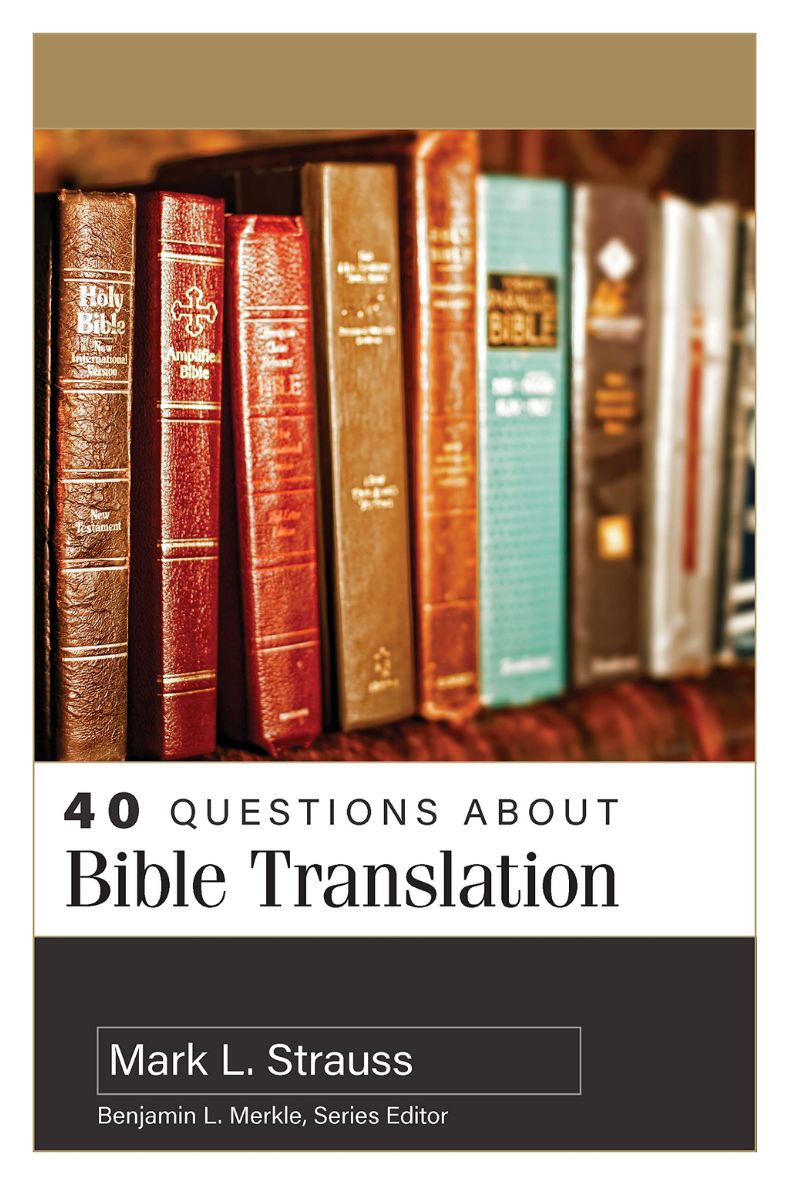
40 Questions About Bible Translation, by Mark L. Strauss. Grand Rapids: Kregel Academic, 2023. 352 pp. $24.99.
NIV translator Mark L. Strauss uses Kregel Academic’s 40 Questions format to excellent effect as he answers 40 Questions about Bible Translation. In the first of six parts in his book, he covers the necessity, goals, and methods of Bible translation, focusing especially on the strengths and weaknesses of formal equivalence translations and of functional equivalence translations.
In the second part, Strauss briefly covers textual criticism and canon (what to translate) before speaking with obvious intelligence to several other preparatory questions: Should you make a revision or a new translation? Should you work with a committee or do individual translation work? How should your theological perspective play into Bible translation? Who is your audience? What reading level and social register are you aiming at? When and where will you “transculturate” rather than translate or transliterate—will you do so with coins, weights and measures, animals?
In part 3, Strauss speaks with rich experience and numerous examples through challenges that Bible translators face. He discusses the translation of difficult words and collocations; of idioms; of poetry and metaphorical language; of figures of speech. He discusses when and whether implications should be brought out by translators—should “Asia” be explained; should “River” be added to “they went down to the Jordan”? How should translators deal with euphemisms, with weights, measures, money, and time? How should they handle the complex and controversial matters related to gender language in Scripture? How should they format their work?
Part 4 brings Strauss to the history of translation, and he reaches back through the King James Version (which gets several chapters) to medieval and ancient translations.
In part 5, Strauss discusses contemporary English translations, summarizing the character and some of the history of popular formal, functional, and “mediating” versions. His discussion ranges as far as The Message, the Cotton Patch Version, The Voice, and the Black Bible Chronicles.
Part 6 answers basic questions about international Bible translation, including discussion of major Bible versions available today and languages that still lack Bibles. Question 40 brings up the still hot topic of Muslim Idiom Translations.
Strauss cannot really be said to have a thesis; it would be difficult to write a useful 40 Questions book that does—they are necessarily wide ranging. Neither does Strauss attempt to break new ground in this book; that is not its purpose. Its value lies in representing the state of play for evangelical Bible translation, what might be called the centrist position. The NIV, which Strauss has worked on for some years, is nothing if not centrist. Indeed, he places it in his “mediating” category (along with the NEB/REB, NET, (H)CSB, and CEB), between the formal (NASB, NKJV, NRSV, ESV) and functional (TEV, NCV, CEV, GW, NLT) English Bibles.
Some might wish to see the center shift back to where it was when the KJV bestrode the English-speaking church like a colossus, with one foot on each side of the Atlantic. But that center has clearly and empirically moved, and Strauss both assumes this fact and argues for it, mainly by demonstrating how well it works. That is, if the major modern English (Protestant) Bible translations are viewed as representing God-given poles in the task of translation—accuracy vs. readability, form vs. function—then it is to be expected that translators will characteristically lean one way or the other. And perhaps, then, the way to solve the perennial difficulty of choosing form or function is to hold on as tightly as one can to both from a spot halfway between them.
Indeed, in a world in which it can sometimes feel like one must choose to be on Team Formal or Team Functional, it is refreshing—and even a little bracing—to hear an NIV translator list strengths for formal translations and weaknesses for functional ones. If I may pick one major, significant strength of Strauss’s book, it is that he is disarmingly self-critical. He favors his own NIV, but he is not at all blind to the perennial criticisms it has faced, mostly for being too interpretive. He has clearly thought through those criticisms carefully, and he is able to see the truth in them. The ring of truth in disputed matters is, I think, with the person who is able to see weaknesses in his own position. And I note that at least one very conservative Bible translator (my friend Aaron Shryock, who has been affiliated with the Tyndale Center for Bible Translation at The Master’s Seminary) has written a positive review of Strauss’s book.
If I must point to a weakness in Strauss’s book, it is one with which I am sympathetic and one I believe would have been very difficult to avoid: there is some audible frustration in his tone when he works through the inclusive language debate. Strauss is too personally invested in this controversy to speak dispassionately; he was very much a participant in the dispute. And now, a few decades after its apogee in 1997, Strauss sighs a bit as he recounts the story:
Ironically, many of those who twenty years ago were vehemently attacking the revisers of the NIV for their use of gender-inclusive language are now adopting this same language in their own versions. This would seem to provide a measure of vindication for those who insisted all along that the goal was to achieve gender accuracy, not gender-neutrality (159).
The “gender-inclusivity” controversy has died down, though it is clearly not dead yet—and may reignite. Complementarians such as Strass are not united around the center Strauss proposes. Perhaps, again, it would be impossible to write about this matter in a merely academic and descriptive way. It would also make for a less interesting and valuable book.
Mark Strauss’s 40 Questions about Bible Translation combines the values of several different kinds of books. It speaks intelligently about the basic task of Bible translation. It offers efficient assessments of major evangelical English versions. It weighs in on current translation controversies. It teaches some important Bible translation history (introductory texts, it seems to me, do not usually mention ancient Bible translations such as the Coptic, Armenian, Georgian, and Slavonic). And it manages all this within the enjoyable and sprightly structure of the 40 Questions series. Even those who are not persuaded by the (now centrist?) view on gender language in Bible translation will find this to be an excellent text to assign for upper-class undergraduates and early seminary students. It is difficult to imagine a better introduction to the field of Bible translation, at least for English speakers.