
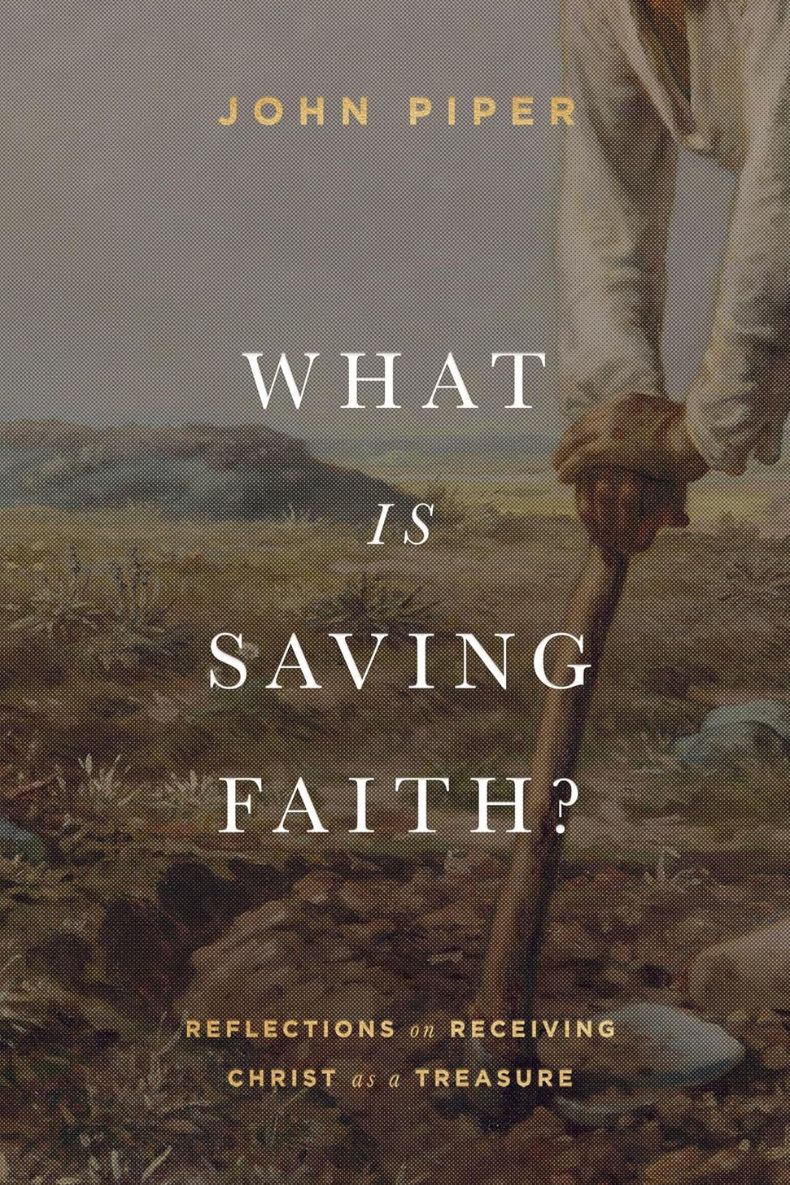
What Is Saving Faith? Reflections on Receiving Christ as a Treasure, by John Piper. Wheaton, IL: Crossway, 2022. 304 pp. $23.99.
John Piper, famously committed to the priority of the gospel, says, “There are a thousand needs in the world, and none of them compares to the global need for the gospel.” People who realize their own desperate need feel like responding. That felt and real need is the focus of Piper’s newest book. The author is founder and lead teacher of desiringGod.org. He is also former pastor for teaching at Bethlehem Baptist Church and current chancellor of Bethlehem College and Seminary. Piper has written more than fifty other books.
In the book’s first chapter, “The Roots of My Concern,” the author addresses the affective aspect of faith in its historical and theological depth. The second chapter, “Seeing Reality through Six Hundred Lenses,” reflects on the many and diverse ways of looking at our faith including our feelings. As a corrective, the author prescribes nine clarifications. In chapters three and four, “Receiving Christ as Our Supreme Treasure” and “Christ the Believer’s Treasure and Satisfaction,” Piper summons believers to examine their faith for its emotional veracity. In a nutshell, faith feels. The final chapter, “Calling for Faith When Faith is Affectional,” explores Piper’s convictions about the essential nature of feeling our faith as a response to God. From cover to cover, John Piper echoes the dictum for which he is best known: “God is most glorified in us when we are most satisfied in him.”
In our soul care, we often hear people say, “Sometimes I just don’t feel like I’m saved.” These words echo in our mind’s ear along with what we say in response. We may not feel like we handled it well. What is saving faith? Many ask this question, but not all are looking for the same kind of answer. Piper queries, “Does the very nature of saving faith include a treasuring of Christ as supremely valuable—that is, an affectional dimension that may hold the key to why saving faith necessarily severs the root of sin and bears the fruit of glad obedience?” (32). In short, he asks, “Is faith really an experience?” Or is it, as some argue, an act of the will? “Not about affections but about volitions” (12).
What are affections? “Does saving faith include any element of love for Christ, or admiration, or adoration, or treasuring or cherishing, or delighting, or thankfulness, or revering? All these words are affectional. They represent experiences in the human soul that I am calling affections” (13–14). As a point of grammar, all these terms are abstract nouns, they describe acts, events, or experiences. They are heart actions. We might rightly ask ourselves, what our heart is feeling in response to anything. The author clarifies what he means by experience.
I am asking about the experience of saving faith—what are the conscious dynamics of it? What is it like in the head—the reason? What is it like in the heart—the affections? What is it like to experience it?… I want to know what the Bible reveals to us about the experience of faith. What is its nature? Faith is not a theory. It is not an idea. It is experienced in the mind and heart, or we are not saved (12–13).
If this so, what is the source of affections? The author says, “I am thinking of them as the special work of the Holy Spirit…the love, delight, and satisfaction I am asking about are not merely natural human experiences. They are divine gifts. They are the work of the Spirit” (14). The implications of this point lead the author to ask the question about cause and affect/result:
I am not asking if such affections are the result of saving faith. I am asking whether such affectional realities are in the very exercise of faith itself. That is, are they part of the nature of faith? Are any of these affections so integral to saving faith that, if they were not there, we would not have saving faith…. Saving faith has affectional elements, without which the faith is not saving…. Jesus saves, and faith is the Spirit-given human instrument through which he does it…. Faith is the instrumental cause (not the ground) of our justification (15–16).
Several questions beyond the book’s content might be worth considering: First, although the author has given us a treatment of the topic, we might have expected a discussion or mere mention of anthropopathism. If we are repeatedly called on in scripture to feel like God does, what are God’s feelings like? Does the divine nature make these feelings different for God. If so, how so? Since the essence of feeling or experience is at the center of the book’s message, what God’s feelings and experiences are like should be important.
A second matter is beyond the scope of the present volume but remains an issue with which we must reckon. We know that the heart is the center for thinking, feeling, and willing. These functions (not body parts or locations) describe what our heart does. But we may not legitimately force distinctions among these three functions. Is willing that much different than thinking? And to the point of this study, is feeling a separate function from the other two? If it is not, then should we argue that one gets the priority in exercising faith over the other two?
We must thank John Piper once again for taking us to a deeper level of commitment to Christ. This reviewer highly recommends the book to all who counsel as part of their ministry, indeed, to any Christian who wants to understand better and appreciate the feelings associated with their faith.