
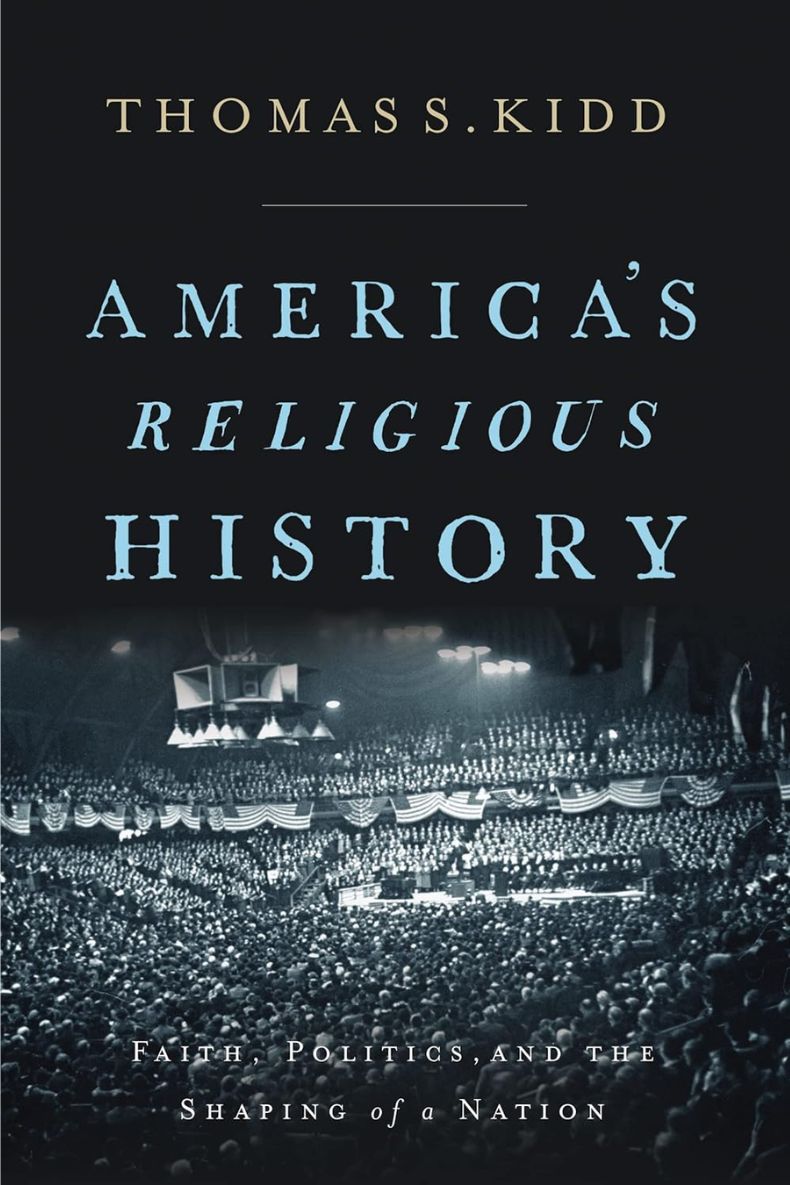
America’s Religious History: Faith, Politics, and the Shaping of a Nation, by Thomas S. Kidd. Grand Rapids: Zondervan Academic, 2019. 313 pp. $24.99.
The initial decades of the twenty-first century have witnessed conspicuous displays of violence that have been religiously motivated, such as the Jihadist attacks in New York and Washington, D.C. on September 11, 2001, or the numerous shootings at various houses of worship (Christian and non-Christian alike) over the last several years. Religion also drives much of the political conflict over contentious cultural issues like abortion and same-sex marriage. Yet, there are also instances of what scholars identify as “lived religion,” or personal acts of devotion. Together all of these show the persistent role of religion in American life, albeit one that has been, and continues to be shaped by increasing diversity. This is the central thesis of America’s Religious History: Faith, Politics, and the Shaping of a Nation, by eminent and prolific historian Thomas S. Kidd. Kidd supports his thesis by constructing a narrative that includes the contributions of figures often omitted from other religious histories of America which give almost exclusive attention to the thought and careers of white male clergymen and politicians. Kidd presents a comprehensive and dynamic story whose plot develops through the simultaneous interplay of conflict, diversity, and devotion. Without ignoring the presence of non-Christian religions in the United States, the author devotes his examination mostly to Christianity, and more specifically to Protestantism, since it functioned as the dominant force in the shaping of America’s religious culture throughout most of its history, while also due consideration to Catholicism.
Following relatively brief surveys of religion in the colonies in chapter 1, the work takes up the effects of the First Great Awakening in chapter 2, where sustained attention is given to the ministry of Anglican revivalist George Whitefield (1714–1770), who, Kidd notes, would serve as something of a paradigm for future evangelists like D. L. Moody (1837–1899) in the nineteenth century, and Billy Graham (1918–2018) in the twentieth. Chapter 3 details the role of religion during the American Revolution. It is here where the author explores the phenomenon of “civil spirituality” that generally characterized late colonial and revolutionary culture and provided the common framework in which Christians, like Roger Sherman and Patrick Henry, as well as Deists, like Thomas Paine and Thomas Jefferson, made use of biblical rhetoric in public discourse in order to frame the War of Independence and the cause of independence itself. Significantly, Kidd discusses the role of the African-American preacher Lemuel Haynes (1753–1833) who, in his important work Liberty Further Extended (1777), argued that the God-given principle of human equality averred in the Declaration of Independence needed to be extended to most unfree American slaves.
Chapter 4 examines the religious diversity spawned by both ecclesiastical disestablishment and the Second Great Awakening, which encouraged the proliferation of sects such as the Disciples of Christ, the Millerites (later the Seventh-Day Adventists), and the Mormons. Following a treatment of global and domestic missions in chapter 5, are critical discussions on slave religion and, in chapters 6 and 7, the slavery controversy that helped precipitate the Civil War. Through the religion of their masters, the slaves adapted Christianity in such a way that it served as a means of indicting Christian slaveowners with denying the gospel by preserving and justifying the institution of slavery. Moreover, though the Civil War was not a religious war, it was certainly cast in biblical terms. For African Americans, the hardships of the war led to their emancipation as well as the institutional independence of the black church. Ultimately, the slave issue inflicted lasting damage upon many traditional white-led denominations.
Chapter 8 traces the manner in which the white-dominated Protestant order was challenged by immigration throughout the nineteenth and early twentieth centuries. In fact, Kidd documents specific instances in which both state legislatures and Congress tried to protect this culture by perceived threats to it with such measures as the Chinese Exclusion Act of 1882. Internal challenges to white Protestant hegemony posed by the theory of evolution (which reached its climax by the Scopes Trial in 1925) and higher criticism, as well as the fundamentalist response to them is covered in chapter 9. Chapters 10 and 11 discuss how the Depression and the two World Wars caused many to lose their spiritual innocence while at the same time left America an economic and military superpower engaged in a struggle with Communism as epitomized by the Soviet Union. It would be this conflict with godless Communism that shaped post-war civic religion around the notion of “Judeo-Christian” values, which further gave rise to the public ministry of Billy Graham, who in turn began the long relationship between white evangelicalism and the Republican party by urging Dwight D. Eisenhower to run for President. Yet, this “Judeo-Christian” civic religion supported by white evangelicalism faced significant challenges again not only by the Civil Rights Movement and various Supreme Court rulings, but also by cultural opposition to traditional morality during the 1960s and 1970s. The perceived threat that these challenges posed ultimately fueled the rise of the Religious Right within white evangelicalism, which bolstered the election of Ronald Reagan as President in 1980. These events form the discussions in chapters 12–13. An important observation made by Kidd throughout these chapters is that even though white evangelicalism has largely aligned itself politically with the Republican Party, African-American and Latino evangelicals do not. Chapter 14 concludes with the assessment that, despite the increasing number of people who do not identify themselves by a specific religious affiliation, they still largely practice some kind of personal faith. Thus, religion in America is still thriving even apart from largely traditional white Protestant institutions.
America’s Religious History is an accessible compendium of the most current scholarship in the field of American Christianity. It is clearly written to serve as a helpful introduction to pastors and laypeople who are interested in a survey of American Christian history based on the best research, and presents the reader with an account that acknowledges both the diversity and complexity of the Christian faith in the United States in its many institutional and devotional manifestations. It is also a useful text for undergraduate courses in modern church history. America’s Religious History is indeed an invaluable aid to the American Church.