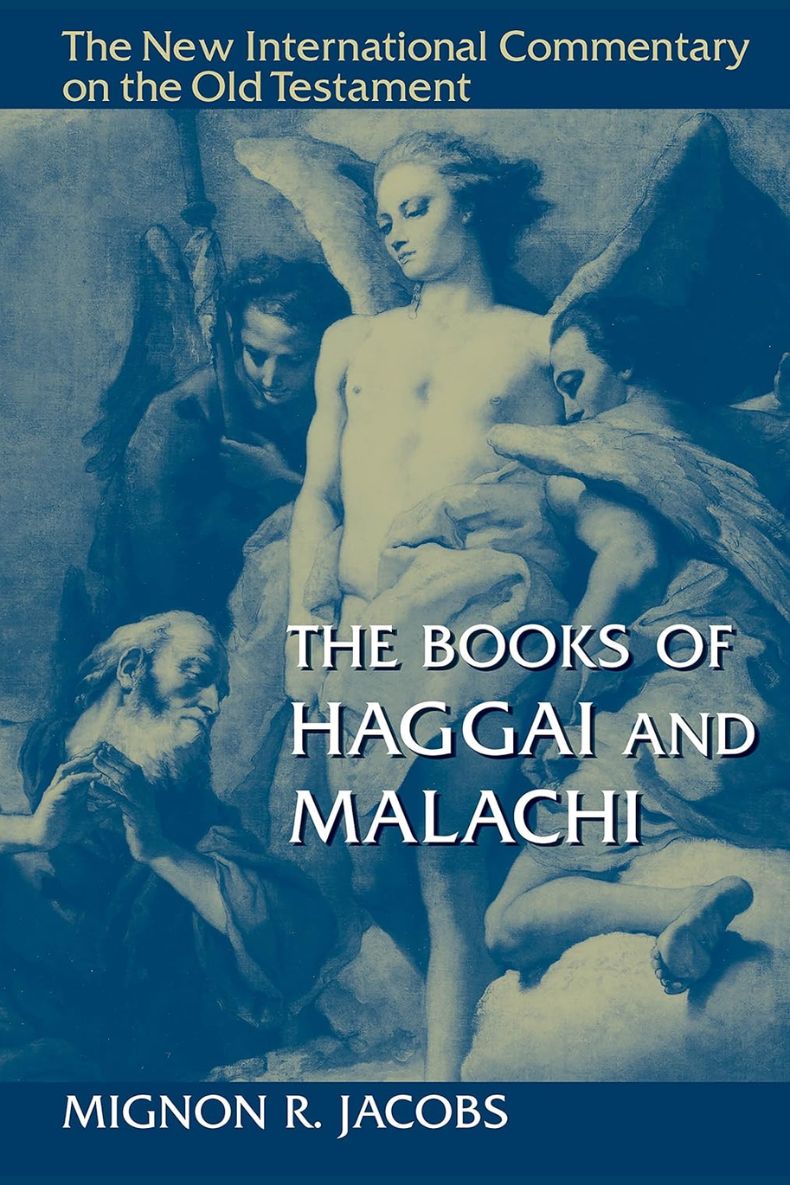
The Books of Haggai and Malachi, by Mignon R. Jacobs. New International Commentary on the Old Testament. Grand Rapids: Eerdmans, 2017. xlv + 377 pp. $48.00.
Mignon Jacobs is professor of Old Testament and academic dean at Ashland Theological Seminary. Her contribution to the NICOT series represents the twenty-seventh publication in that series and the first NICOT volume to replace a previous work, in this case the 1987 commentary on Haggai-Malachi by Pieter Verhoef.
The commentary takes seriously the historical claims of these postexilic books and argues for their literary integrity. The commentary falls within the explicit aims of the NICOT series: to provide high-quality, up-to-date biblical scholarship from an evangelical perspective (although such an aim is problematized by evangelicalism’s growing diffusion and lack of clarity) (see “General Editor’s Preface,” xi–xii). Jacobs presents the message of Haggai as focusing on the importance of obedience in the rebuilding of the temple with an emphasis on the hope springing from Yahweh’s involvement in the community’s life and protection of the community’s well-being (28–29). The message of Malachi portrays the fractured relationship between Yahweh and his covenant people, with focus on the “dissonance and impasse” that have occurred from the clash between expectations and experience (151). Malachi emphasizes God’s actions in sustaining the relationship with his people.
With respect to her conclusions on exegetically-significant passages, the following are typical. First, an interpretive question emerges from Haggai’s prophecy that Yahweh would shake the nations so that they bring their “desired thing(s)” or “treasure” (חֶמְדָּה) to the temple for Yahweh to fill it with glory (Hag 2:7). Many conservative interpreters see here an eschatological prophecy concerning the glory of the temple in the messianic and/or millennial age. Although Jacobs is somewhat unclear in her conclusion, she seems to suggest that the prophecy is fulfilled in the Persian period as Yahweh promises to “exceed the community’s experience and exceed even the expectations borne out of the tradition about the opulence of the Solomonic Temple” (90). The prophecy functions, then, mainly as a rhetorical charge for Haggai’s audience to galvanize them in their continued efforts to finish the construction of the temple, a view often held by critical scholars.
Second, a significant interpretive issue emerges in Hag 2:23 with the seeming tension between Haggai’s endorsement of Zerubbabel as Yahweh’s signet ring and Yahweh’s earlier curse upon Jeconiah, the failed signet ring, and his descendants in Jer 22:24–30. Rather than espousing a messianic/typological interpretation or advocating a reading of the Jeconiah curse as hypothetical, Jacobs suggests, following Carroll, that Haggai has reconceptualized or adjusted the earlier prophecy so as to reveal “altered standards for installing someone from the line of David” (124). Haggai’s prophecy thus corrects Jeremiah’s earlier pronouncement in the light of the postexilic context in Yehud.
Third, a significant question revolves around the meaning of Yahweh’s perspective concerning divorce in Mal 2:16. The interpretive challenges here are multifarious. Jacobs translates the text in question as “because he [the One] hates divorce” (251). In her explanation of the text, however, she does not espouse a decisive view but suggests that the one who hates may be Yahweh or the man who divorces. Either option holds value in presenting a distinctive angle on the repudiation of divorce in the postexilic Jewish community (261–62).
The strengths of the commentary are several. Jacobs has an engaging and concise writing style. She is current on many of the scholarly issues surrounding these books (although, see below) and brings these discussions up to date. She is insightful in her analysis of distinctive phrases and idioms that appear in the books. She often assesses the significance of these phrases by examining their usage elsewhere in the OT in a way that offers additional light on their meaning (e.g., her development of the peace traditions in Haggai [92–93]).
Beyond this, however, several shortcomings diminish the value of the volume. First, the author chooses consistently not to champion interpretive positions but simply to list various interpretive options. This tendency lies in contrast with her predecessor and will likely frustrate readers who are preparing sermons or lessons on the text. For the latter, clear interpretive positions carry more value when preaching or teaching Scripture to the congregation, and the reluctance to take a conclusive position inadvertently downplays the importance of meaning. Second, the author’s engagement with text-critical issues proves quite superficial vis-à-vis the Verhoef volume. Jacobs hardly treats any textual issues beyond minimal interaction with the LXX and the NRSV. Scant mention is made of Qumran, the Syriac Peshitta, the Targums, the Old Latin, the Vulgate, or other versions. Third, the author surprisingly overlooks the growing corpus from two decades of scholarly work on intertextual connections within the Book of the Twelve. In her section on Haggai entitled “Intertextual Indicators,” she examines preexilic prophets and postexilic historical books in a diachronic manner (helpful as this is) but ignores the fruitful synchronic connections within the Book of the Twelve (on this see, e.g., the essays on Haggai and Malachi in Rainer Albertz, James Nogalski, and Jakob Wöhrle, eds., Perspectives on the Formation of the Book of the Twelve: Methodological Foundations—Redactional Processes—Historical Insights [Berlin: de Gruyter, 2012]).
In summary, I find the earlier volume by Verhoef to be more instructive on many points, and I still prefer a number of other commentaries over Jacobs’s recent installment. I therefore do not commend the commentary as a top choice on Haggai and Malachi, although students and pastors who wish to do in-depth study may want to consult it.