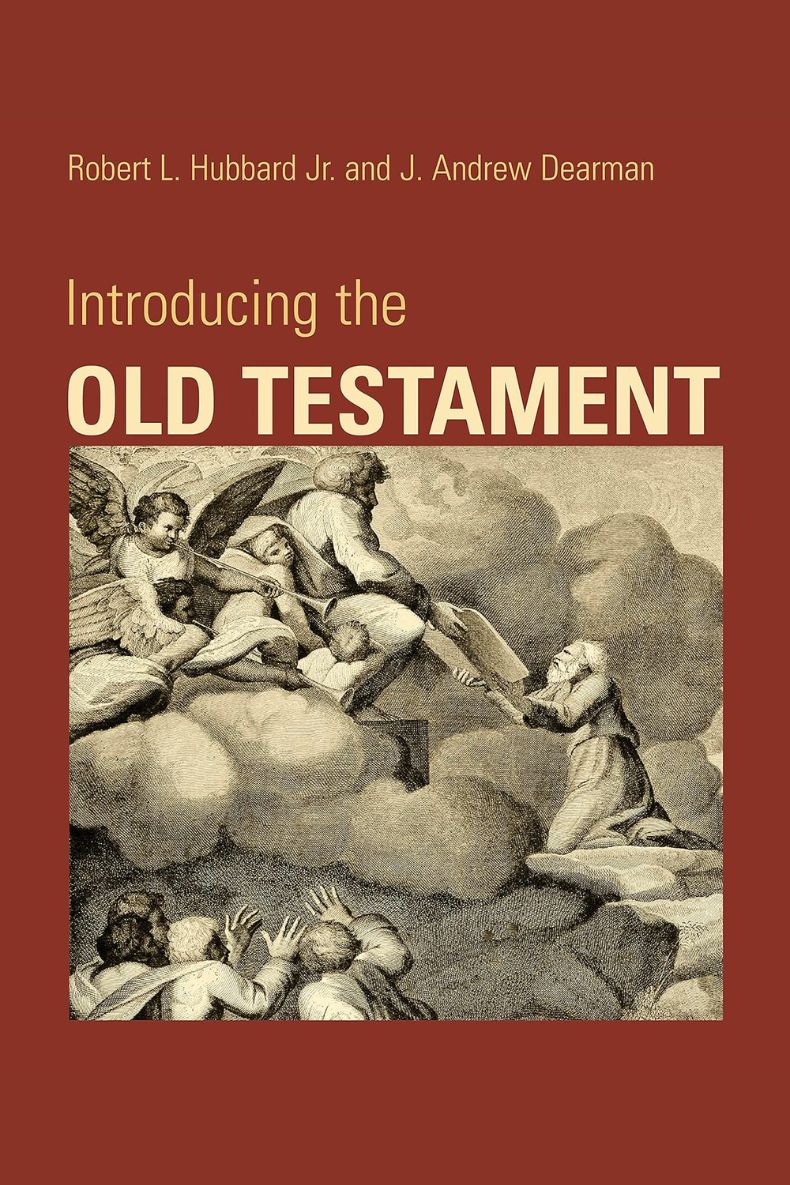
Introducing the Old Testament, by Robert L. Hubbard, Jr., and J. Andrew Dearman. Grand Rapids: Eerdmans, 2018. xxi + 538 pp. $40.00.
Robert L. Hubbard, Jr., serves as professor emeritus of biblical literature at North Park Theological Seminary in Chicago, while J. Andrew Dearman is professor of Old Testament at Fuller Theological Seminary. Both scholars bring decades of research and teaching experience to their task, with this book hailed on its back cover as an “up-to-date, student-friendly text—the best available Old Testament introduction for university and seminary students.” While the authors favor a literary approach to the OT, they acknowledge that questions of historical context cannot be avoided (4–5).
The book divides into six sections. The first part comprises two chapters with a brief introduction on methodology and a survey of the historical context of ancient Israel. The authors compare their approach to swimming lessons: the beginning portion of each chapter provides practice time in the shallow end of the pool before diving into the deep end with culminating reading sections where the reader engages the OT itself. Their approach likewise follows the pattern of highlighting seven programmatic texts, which they characterize as “key biblical statements that articulate the OT’s foundational theological themes” (3). These texts include Gen 12:1–3; Exod 19:4–6; 34:5–7; Lev 11:45; Num 6:22–27; Deut 6:4; and 2 Sam 7:11b–16. Some readers might quibble over the exclusion of other seminal texts, such as Exod 6:7; Lev 26:12; Deut 6:21–23; 26:5–9; and Jer 31:31–34 (see, e.g., Mark J. Boda, The Heartbeat of Old Testament Theology, 11–57), but the authors have chosen significant texts that unpack the message and theology of the OT.
The second section comprises seven chapters, starting with an introductory chapter examining the question “What is the Torah?” In characterizing the Torah the authors conclude that it is an anonymous literary work, claiming that “the OT nowhere directly names the person(s) responsible for the Torah” and that there is no record of how the books came to be or were collected (31). Rather, they suggest that the Torah was completed by Ezra in the mid-fifth century bc. This assertion flies in the face, however, of clear and consistent OT links between the Torah and the figure of Moses (1 Kgs 2:3; 8:53; 2 Kgs 14:6; 2 Chron 23:18; 30:16; 35:12; Ezra 3:2; 7:6; passim). The introduction is followed by six chapters surveying each of the books of the Pentateuch, with Genesis encompassing two chapters. The authors sidestep significant interpretive questions in Genesis 1–11, such as the age of the earth and the geography of the flood (global vs. local), while hinting that they tilt toward old-earth and local-flood positions (see 42–46). They argue nonetheless for the historicity of the patriarchs (53). They advocate a 1280 bc date for the exodus (60) and suggest that the plagues were not intended as an assault upon the Egyptian pantheon (66). With respect to the authenticity of Deuteronomy, the authors propose that the book “originated with reform-minded circles during the monarchic period, who drew upon Mosaic tradition” (91) and that the writing took shape to galvanize Josiah’s reforms.
The third section covers the historical books with ten chapters. Two chapters serve as introductions to the historical books themselves (chap. 10) and to the postexilic historical books (chap. 16). The authors avoid questions relating to the nature of the so-called Canaanite genocide, while treating briefly the archaeological questions revolving around the destruction of Jericho, Ai, and Hazor (129). In their survey of 1–2 Samuel, the authors highlight the Davidic covenant text as central to the selection of the Davidic line and of Jerusalem in the outworking of God’s redemptive purposes (168). The historiography of Joshua–Kings is depicted as that of the exilic Deuteronomist (116, 195).
The fourth section examines the prophets. Two introductory chapters offer a valuable overview of the nature of OT poetry (chap. 20) and the background of OT prophecy (chap. 21). In the opinion of this reviewer, these chapters are among the most helpful of the book. The authors argue for three voices or personas in Isaiah (293–96) and for a Maccabean origin for the book of Daniel (333). The authors treat the Minor Prophets individually, muting somewhat the contemporary scholarly focus on literary connections among the books as a unit.
The fifth section investigates the poetic books, with seven chapters. In the first chapter the authors examine the question “What are the wisdom books?” The chapter on Psalms is insightful, with a helpful overview of psalm genres and a concise distillation of contemporary findings on the nature of the Psalter as a book, analyzing how the literary structure affects the reading of individual psalms. The authors argue against Solomonic authorship of Ecclesiastes (447) and against an overarching plotline in the Song of Songs (466). The final section is an overview of the canon of the OT, with lengthy discussions on the formation of the canon, the nature of the apocryphal books, and the significance of ancient translations in assessing the textual basis of the OT. Their analysis extends into the fourth century of the church and to the work of Jerome and Augustine.
Several strengths and weaknesses of the book merit mention. As to strengths, the book is visually appealing, with color photographs and attractive sidebars on nearly every other page. The authors’ writing style is winsome and engaging. The book is arranged purposefully to facilitate the classroom setting with helpful summaries, discussion questions, and bibliographies at the end of each chapter. In addition, the authors navigate well the literary features of the OT, as each book is analyzed in terms of its literary structure and its connection to the larger biblical theology of the OT. Yet a few weaknesses diminish the value of the book significantly. First, the authors consistently argue against conservative interpretive positions, advocating (predictably) critical stances with respect to authorship and dating in almost every case. Second, the authors surprisingly fail to interact with important interpretive questions across the span of the OT, such as the challenge of large numbers in the Pentateuchal censuses, the nature of violence in the Canaanite conquest, and the difficult chronology of the Judges period, just to name a few. For this reason, the OT introductions of Gleason Archer and especially of Merrill, Grisanti, and Rooker are much more useful for biblical students wrestling with interpretive difficulties and more agreeable to traditional evangelical positions on chronology, backgrounds, and authorship. Thus, while the book contains material that will be helpful to many readers, particularly on the nature of poetry and prophecy, I cannot commend the book as a worthy substitute for the OT introductions just mentioned.