
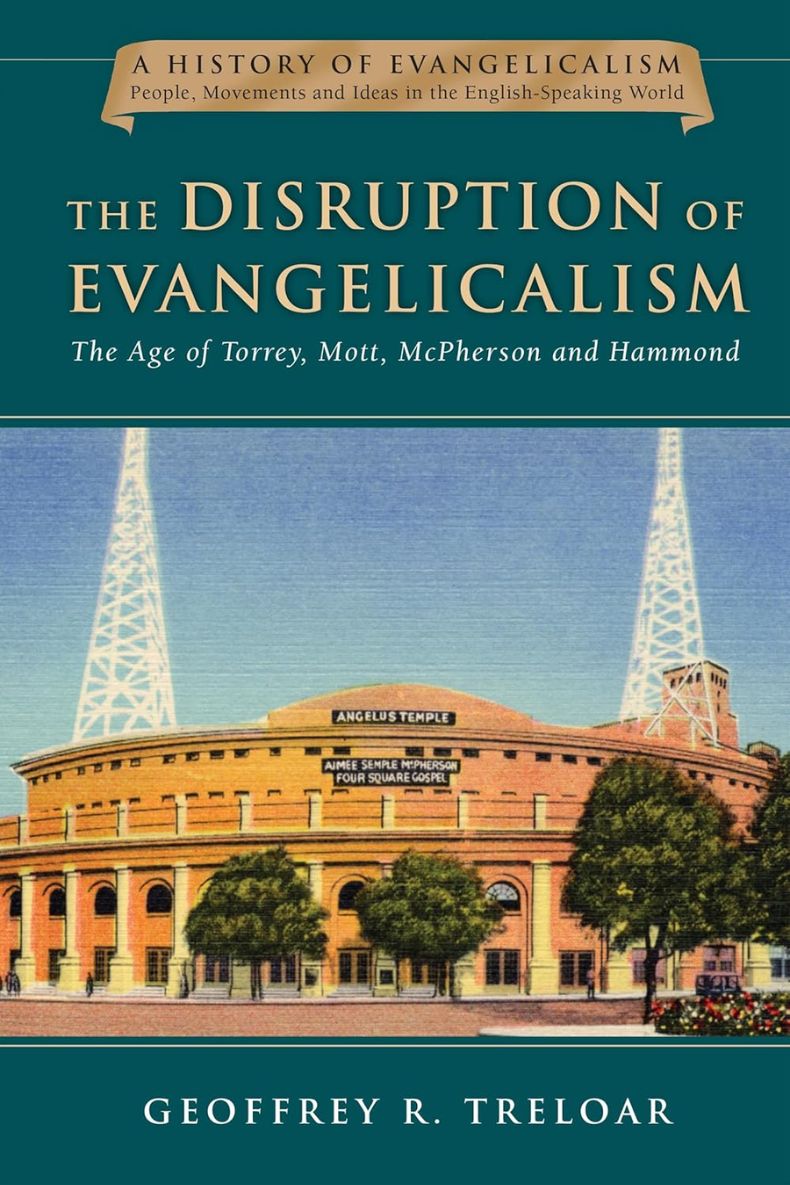
The Disruption of Evangelicalism: The Age of Torrey, Mott, McPherson, and Hammond, by Geoffrey R. Treloar. Downers Grove, IL: InterVarsity Press, 2017. xiii + 334 pp. $35.00.
This is the long awaited final volume (although the fourth in the series chronologically) of A History of Evangelicalism: People, Movements and Ideas in the English-Speaking World, ed. David Bebbington and Mark Noll, that has been in the works for nearly two decades. Treloar, an Australian, writes about the forty-year period of modern evangelicalism from the beginning of the twentieth century through to the early days of the Second World War (1900–1940). The period is complex and the issues far reaching. During these years, the fundamental nature of evangelicalism will grow virtually beyond recognition.
Evangelicalism has been broadly recognized as having four characterizing features, the so-called “Bebbington quadrilateral”—conversion-ism, Biblicism, crucicentrism, and activism. Using this broad complex of ideas, the writers of this series in general and Treloar in particular sketch their impact in the English-speaking world, the global community where evangelicalism by this definition has had its greatest impact.
Starting with the Fin de siècle world of 1900s, Treloar’s history divides into two main time periods (1900–1914) and “Evangelicalism at the Crossroads” (1919–c. 1940). There is a separate discussion on the interlude years of 1914–1918, the Great War years. During this forty-year period, a distinct fracturing of the evangelical consensus occurs, to the point that Treloar must use a series of adjectives to embellish evangelicalism as an idea and to describe the increasingly diverse nature of the movement he is trying to sketch. There are “liberal evangelicals,” “centre-left evangelicals,” “centrist evangelicals,” “centre-right evangelicals,” and of course, fundamentalists, which at times he labels as “anti-modern” evangelicals. Not to be omitted from this staggering theological breadth are the Pentecostals, “marginal to evangelicalism,” such as Aimee Semple McPherson, who becomes his prime exemplar. This bewildering breadth to evangelicalism remains a part of its contemporary nature of the movement and one can understand from reading Treloar why it is this way today.
Treloar does a nice job of sketching the global English dimension of evangelicalism—English Anglicans, American Baptists, Canadian fundamentalists, and New Zealand Adventists are just a sampling of the movements that Treloar includes in his far-reaching discussion. Because of this breadth, the conversation is necessarily brief, and no particular movement gets a full-orbed treatment. The value of the work is in its panoramic view of the global whole. Students of the movement will benefit from an examination of selected works cited in the footnotes, both primary sources and the secondary literature. The grasp of the whole on Treloar’s part is certainly one of the strengths of the work.
Of particular importance to the understanding of global evangelicalism is the increasing interest that evangelicalism has had in social engagement. This can be seen in the nineteenth century with issues like abolition, temperance and women’s suffrage. It continued into the twentieth century with evangelical involvement in labor movements and politics. During the Great War, evangelicals did their part and more in confronting global militarism, pushing for peace at every conceivable opportunity. As the time period of the book comes to an end, evangelicals are involved in challenges like industrial capitalism, the Depression, race, and disarmament.
Those from within a particular tradition may wish to quibble with Treloar’s categories or the individuals whom he places within those categories. For example, as he discusses liberal evangelicals, a term that seems on its face oxymoronic, though one which was used during the years of the liberal hegemony in much of evangelicalism, Harry Emerson Fosdick is cited on a number of occasions as a quintessential example. Treloar discusses Fosdick, “an avowed evangelical,” as he sets forth his “spectrum model that recognizes the continuum of opinion within the evangelical tradition” (13). “The fluidity of the spectrum model… facilitates asking questions about evangelical identity that have seldom been addressed” (15). The significant question in this regard is who gets to decide who is in and who is out.
This of course is a part of the modern dilemma of evangelicalism. Is it a bounded set? A center without a circumference? A quasi-biblical idea that can be shaped like a nose of wax? The evangelicalism of today was shaped by the evangelicalism of yesterday. Treloar does contemporary evangelicals a favor by fleshing out the early twentieth-century permutations and shows the “disruption,” perhaps better, the dissipation of evangelical ideas. If, as Treloar argues, almost everything between Roman Catholicism and the Mormons can be called an evangelical, is there any real significance to the word evangelical?
Treloar is to be thanked for the effort at describing in a concise fashion this forty-year period of evangelicalism’s history. With the completion of this set of books on evangelicalism, the student of evangelicalism will go a long way toward understanding the movement as a whole as it exists today.