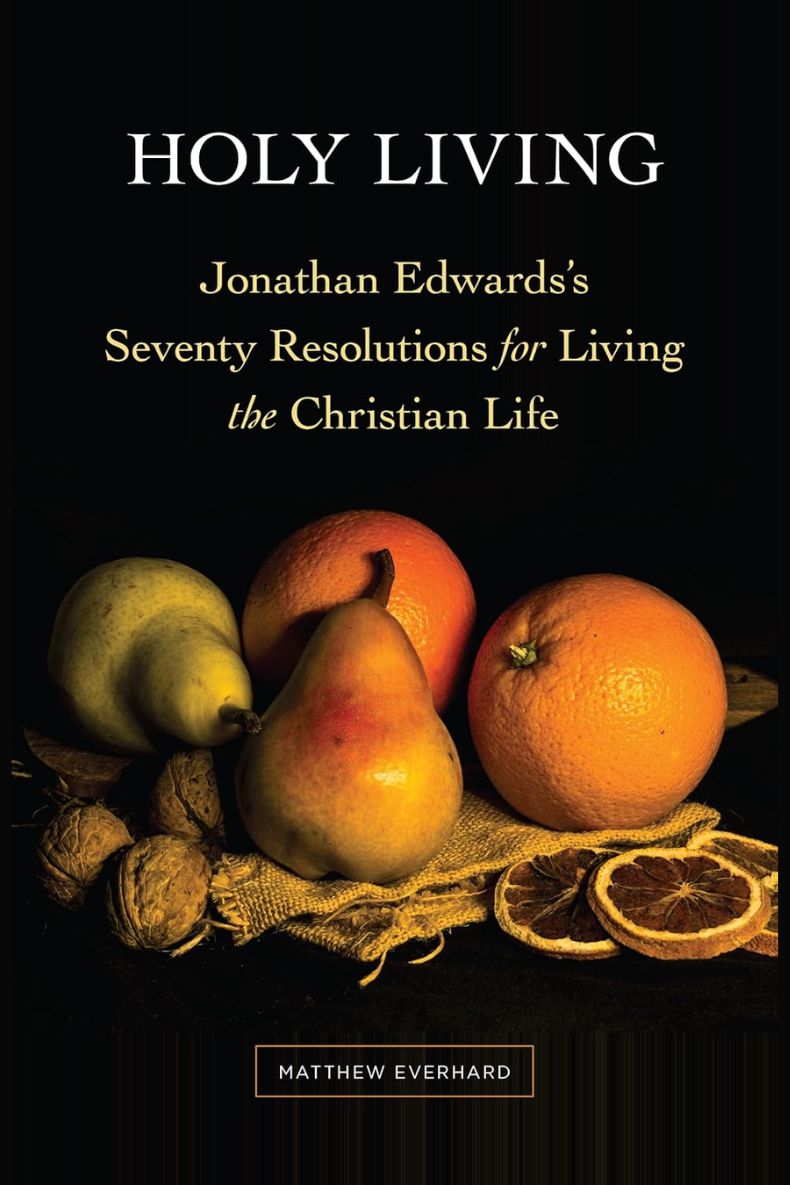
Holy Living: Jonathan Edwards’s Seventy Resolutions for Living the Christian Life, by Matthew Everhard. Peabody, MA: Hendrickson, 2021. 163 pp. $16.95.
The year 2022 marks three hundred years since Jonathan Edwards began writing his seventy “Resolutions.” To commemorate this anniversary, Matthew Everhard has written a book which takes readers on a theological and devotional walk through this famous document. The first chapter offers a brief biography of Edwards. Here, Everhard indulges in a bit of hagiography. On the first page alone he lauds his subject as “America’s first incomparable intellect,” “a polymath,” “the American Colonies’ most gifted individual,” and more. He also repeats the common misconception that Edwards spent his time in Stockbridge “re-preach[ing] some of his simpler sermons and focus[ing] instead on writing some of the major treatises.” Otherwise, it is a good biography.
The main body of the book consists of three chapters, which correspond to the three main groupings of Resolutions that Everhard has identified. He labels them “Existential Resolutions,” “Ethical Resolutions,” and “Eschatological Resolutions.” Readers may find the categorization of each resolution somewhat arbitrary. For example, under the category “Eschatological Resolutions,” Everhard includes such resolutions as #5: “Resolved, never to lose a moment of time; but improve it the most profitable way I possibly can”; and #67: “Resolved, after afflictions, to inquire, what I am the better for them, what good I have got by them, and what I might have got by them.”
As he works through each resolution, Everhard very skillfully correlates them with entries in Edwards’s Diary and other extant writings to provide a good picture of the historical context behind each entry. The result is an Edwards that appears not so different from the rest of us. As Everhard says in his first chapter summary, “[Edwards] argued with his parents, doubted his own conversion, struggled with indwelling sin, and through it all sought refuge in Christ” (61). As Everhard weaves in his own illustrations and applications throughout the book, he also seeks to make Edwards’s “Resolutions” profitable for contemporary readers’ sanctification.
The concluding chapter seeks to answer the questions, “Why did Edwards stop using the Resolutions?” and, “Why did he apparently cease examining himself so excruciatingly in his Diary by those Resolutions he had already written?” (148). In answer to the first question, Everhard speculates that Edwards simply viewed his “Resolutions” as complete.
Everhard offers a series of answers to the second question. One answer is that Edwards became too busy with outward duties to continue spending much time on introspection. During the second half of the 1720s he became a pastor under his grandfather, he got married, and he became a father. At the same time, Everhard believes there were also deeper reasons. In his Diary, Edwards indicates that all his introspection was proving more discouraging than he had anticipated. This may have caused him to give up on the project. Also, it appears that he came to believe that his “Resolutions” involved “too great a dependence on my own strength; which…proved a great damage to me” (157). In other words, this method of spiritual growth increasingly seemed at odds with a life in dependence on the Spirit.
In sum, I believe this book is a worthwhile contribution to the field of Edwards Studies. Readers will find the scholarship good, the tone pastoral, and the content readable.