
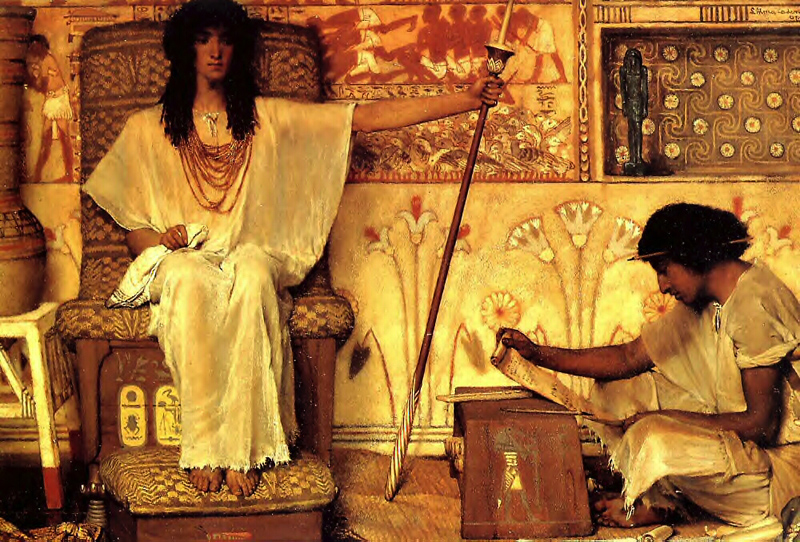
Lately, as a result of three factors I’ve been thinking a fair bit about the potential role Joseph plays in biblical typology. First, I recently read Samuel Emadi’s new book From Prisoner to Prince: The Joseph Story in Biblical Theology. Emadi makes a good case for Joseph as a “rejected, royal deliverer” who resolves the plotline of Genesis by beginning to bring to fruition the land, seed, and blessing promises of the Abrahamic Covenant in spite of the earlier characters’ failure to do so (147).
Second, I’ve been studying Ecclesiastes 8:1–8 for a commentary I’m working on. Some of the fruit of that labor took shape in a paper this summer at the Bible Faculty Summit. I argued there that the writer of Ecclesiastes alludes to the Joseph narrative in three ways when he gives advice on how to navigate the pitfalls of the royal court: (1) He affirms that the wise know the “interpretation/portent” of a word (v. 1). He uses a term that occurs elsewhere only in the stories of Joseph and Daniel as they interpret dreams in a foreign royal court. (2) He advises obedience to the king’s command (literally “the mouth of the king”) (v. 2). This expression occurs elsewhere only in the account of Pharaoh’s command to Joseph to provide wagons of provisions for his brothers as they journey back to Egypt (Gen 45:21). (3) He describes royal rule with a unique word meaning “power/mastery” (vv. 4, 8). This word occurs elsewhere only to depict Joseph as the “ruler” over the land (Gen 42:6).
Third, I’ve begun my seventh time teaching through Pentateuch at DBTS. Each time I teach the course I reflect on the major themes of the Pentateuch and how they introduce key concepts developed later in the biblical canon. Joseph has always intrigued me. He is a character given an extraordinary amount of “face time” in Genesis (chaps. 37–50). In spite of this, he receives scant mention in the New Testament, alluded to only in Stephen’s brief recital of Israel’s history (Acts 7:9–16) and in the “Hall of Faith” chapter (Heb 11:22). This omission would seem to disqualify Joseph as a biblical type if one subscribes to Roy Zuck’s dictum that only types that are identified as such in the NT rightly qualify as biblical types (Basic Bible Interpretation, 179).
Yet the correspondences between Joseph’s life and Jesus’ role as Messiah are striking:
(1) Both are the subject of prophecy concerning their reign over their brothers/kinsmen (e.g., Joseph’s dreams in Gen 37:5–11; Jesus in Isa 9:6–7; Mic 5:2; Dan 7:13–14).
(2) Both are hated, rejected, and “killed” by their brothers/kinsmen (metaphorically in the case of Joseph) (Gen 37:18–27; Mark 8:31; John 15:18, 24–25).
(3) Both are sold by their betrayers for a price: Joseph for twenty pieces of silver (Gen 37:28), Jesus for thirty (Matt 26:15).
(4) Both are stripped of their robe prior to their going down to the “pit/death” (Gen 37:23; Matt 27:28; John 19:23).
(5) Both resist temptation to establish their legitimacy for rule and their steadfast devotion to God (Gen 39:7–13; Luke 4:1–13).
(6) Both experience the power and presence of the Lord and the Holy Spirit with them (Gen 39:2–3, 21, 23; 41:38; Luke 3:22; 5:17).
(7) Both in their period of greatest suffering are associated with two criminals, one of whom is delivered, the other destroyed (Gen 40:1–23; Luke 23:39–43).
(8) Both are thirty years old when they enter public service (Gen 41:46; Luke 3:23).
(9) Both function as priests. This is the case for Joseph in that he likely shaves his body prior to entering Pharaoh’s court (Gen 41:14), a custom associated in ancient Egypt with the Pharaoh and the priestly caste (see L. Fried, “Why Did Joseph Shave?” BAR 33 [Jul–Aug 2007]: 36–41). This explains too his marriage to Asenath, the daughter of a priest (Gen 41:45). Jesus accomplishes his priestly ministry after the order of Melchizedek (Heb 5:5–56) as an atoning sacrifice for sin (Heb 2:17; 5:1) and as an intercessor for his people (Heb 7:23–25).
(10) Both are exalted to reign as vice-regent over foreign nations (Gen 41:40; Pss 22:27–28; 110:1–2).
Beyond these links, there are additional Joseph-Jesus correspondences that fit well with dispensational eschatology. After Joseph’s rise to power, he goes unrecognized by his brothers in their first coming to Egypt. They’ve concluded that Joseph is long dead (Gen 42:13). Joseph thus tests and judges his brothers in what equates to a two-part tribulational period (Gen 42:7–38; 44:1–34). In desperation the brothers come again to Egypt when facing eventual death (Gen 43:1–15). At the conclusion of this return, Joseph finally reveals himself (Gen 45:1). The brothers’ blindness is removed (Gen 45:14–15). This is accompanied by loud weeping and embracing their long-lost, presumed-dead brother (Gen 45:2–3, 14–15). Following their reconciliation, Joseph regathers his family to dwell together and bestows on them the riches of the nations (Gen 45:16–28). They flourish under his reign as he provides the best of the land for them (Gen 47:5–6) and as they multiply in number and prestige (Gen 50:19–23; Exod 1:7). These remarkable affinities with the events of the future tribulational period, the second coming of Christ, and the millennial kingdom, suggest that there is more to the Joseph narrative than meets the eye. Moses preserves key details from the life of Joseph to furnish a pattern of rejected, royal rule, followed by tribulation, reconciliation, and blessing, all corresponding to a dispensational understanding of eschatology. Developing these correlations unveils a little more of the rich tapestry of Scriptural truth.