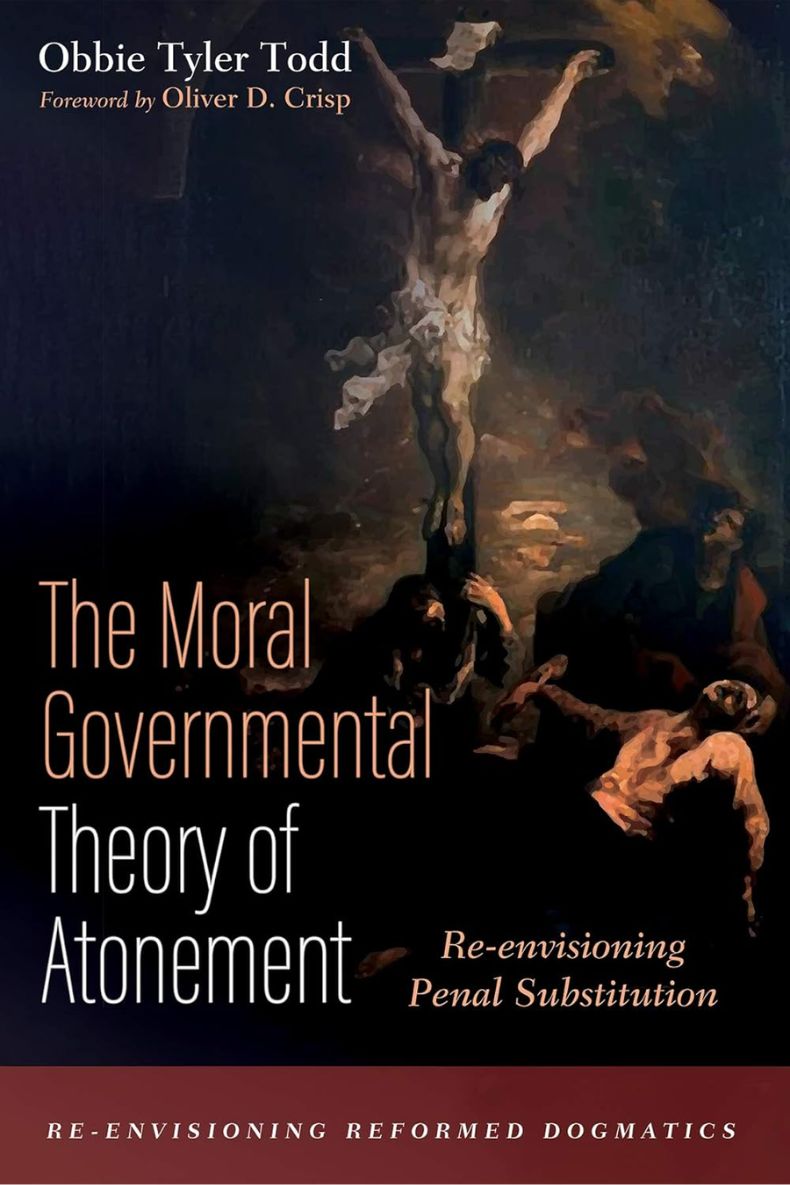
The Moral Governmental Theory of Atonement: Re-envisioning Penal Substitution, by Obbie Tyler Todd. Eugene, OR: Cascade Books, 2021. 213 pp. $27.00.
Obbie Todd’s recent book offers a systematic theology of the moral governmental theory of atonement as it was articulated by the New Divinity. The first part places the theory in its intellectual context. Todd begins with Jonathan Edwards, explaining how some of the familiar themes in the Edwards corpus likely influenced the New Divinity thinkers—particularly Edwards’s distinction between “natural” and “moral” human ability. Todd does a particularly admirable job of explaining both (1) why the governmental theory found its birth in America and (2) why it was such a short-lived phenomenon. The New Divinity ministered in a transitional age as the thirteen American colonies were becoming the United States. Conversations about justice, sovereignty, the principles of good government, etc., were front and center. The moral governmental theory of atonement harnessed these concepts and applied them to the cross of Christ. This contributed to the theory’s particular appeal to late-eighteenth century Americans, but it also explains why the theory did not last. As the conversation in America took a new direction in the late-nineteenth century, this way of describing the atonement was no longer compelling.
The second part of the book covers the five “core principles” of the moral governmental theory: glory, goodness, sovereign grace, public justice, and faith. As he develops these themes, Todd argues that the New Divinity’s theory does qualify as a form of “penal substitution,” though it does re-envision the concept as well. As Todd explains, the theory states that “Christ suffered the equivalent of damnation in order to maintain the honor of the law, to vindicate the Moral Governor, and to achieve the most good for his moral universe. Christ did not endure the actual penalty of the law, but suffered extralegally, non-savingly, and non-transferrably as a substitute for punishments in order to satisfy public (general) and rectoral justice and to open the door for sinners to be pardoned of their sins upon faith by a good and just Ruler” (7).
The third part brings the New Divinity doctrine into conversation with other Reformed thinkers to better demonstrate how it compares and contrasts with the traditional Reformed doctrine of atonement. I found his summary of Warfield’s, Hodge’s Crisp’s, Sweeney and Guelzo’s assessments of the moral governmental theory and its relationship to the Reformed tradition very enlightening. At the same time, I found Todd’s decision to describe the New Divinity as “Christian Hedonists” (65) to be a bit anachronistic.
These critiques aside, readers will find Todd a reliable guide as they seek to understand how the New Divinity’s doctrine of atonement developed, how it was distinct from the traditional Reformed orthodox view, and why it did not endure. Readers may also appreciate his pastoral tone throughout the work. Todd is a pastor, and he communicates like a pastor, sprinkling his work with analogies, alliterations, and applications for the present. In doing so, he has produced a work that can edify scholars and students alike.