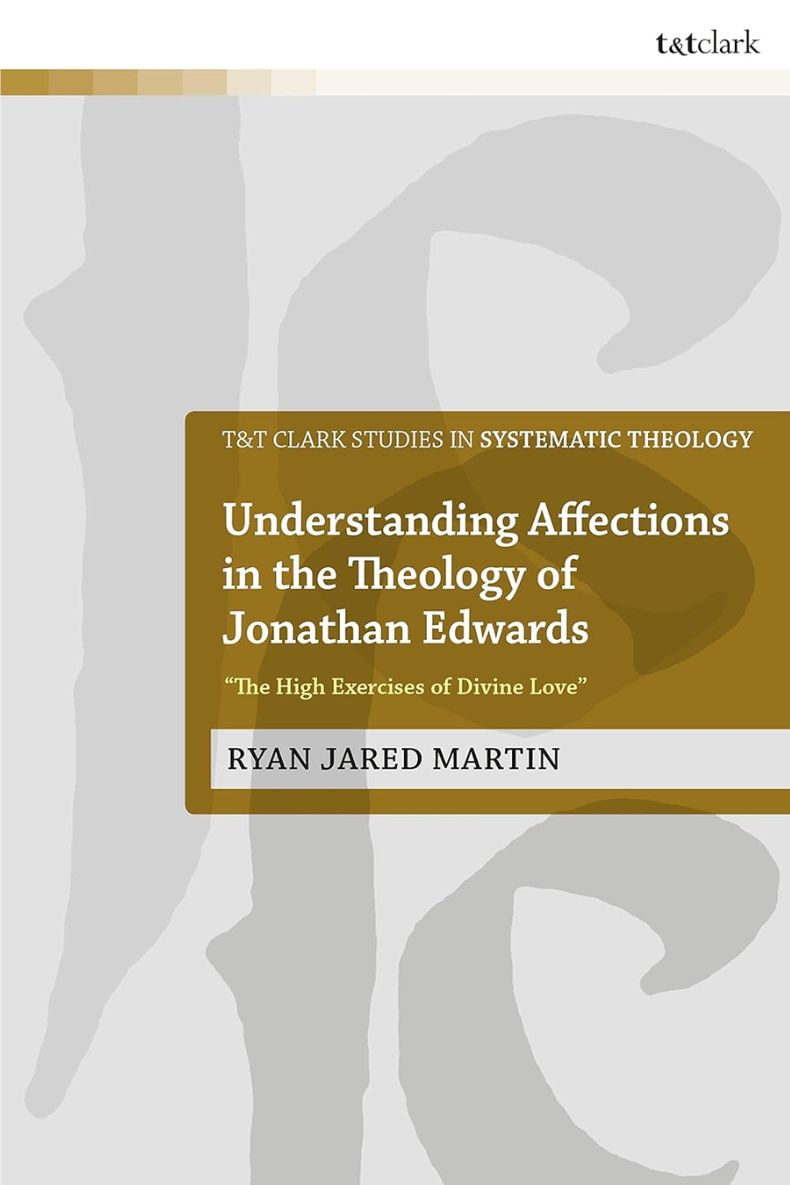
Understanding Affections in the Theology of Jonathan Edwards, by Ryan J. Martin. London: T&T Clark, 2019. xiv + 304 pp. $122.00.
Ryan Martin is the pastor of First Baptist Church in Granite Falls, MN. He recently completed his PhD at Central Baptist Theological Seminary in Plymouth, MN. This volume is substantially his doctoral dissertation. In the interest of full disclosure, I had the pleasure of facilitating a doctoral seminar in which Ryan was enrolled, so I have a vested interest in his academic success.
The purpose of the volume under review is to trace the anthropological category of affections diachronically through church history and specifically to place Jonathan Edwards’s understanding of affections within this historical stream. Martin also aspires (successfully, I believe) to supply a corrective to misunderstandings of Edwards’s views which are current in modern evangelical discussion, where appeals are sometimes speciously made to justify Charismatic and other enthusiastic elements in modern worship.
I first became interested in this topic a few years ago when I read Thomas Dixon’s stimulating tome, From Passions to Emotions: The Creation of a Secular Psychological Category (Cambridge University Press, 2003). Dixon’s burden was to demonstrate that the modern psychological concept of emotions is of recent vintage, an amalgam of older notions such as affections, appetites, and passions, with an emphasis on the latter two. As such, emotions is at best an imprecise synonym for the three older categories, but most inadequate for the affections. As such, to read older discourses on affections as discussions of emotions begets not only confusion, but also conclusions that much different from the original intentions. I was delighted to see Martin reference Dixon on the very first page, and also to see him identify several implications of Dixon’s work for the Christian community.
The first three chapters of the book (a little more than a third of the material) expand a single field of Dixon’s cross-disciplinary research, viz., the field of Christian theology. The burden here is to distinguish between appetites, affections, and passions in the whole history of the Church until Edwards—no small feat in view of the many languages in which these concepts are represented. The definitions that emerge are, of course, not perfectly univocal; still, much consensus materializes. If I may summarize Martin’s findings, I would say the following:
- By appetites are meant those psychosomatic impulses directed toward the satiation of finite creatures’ needs and desires (e.g., hunger, thirst, the need to reproduce, etc.). These may be suppressed, delightfully satiated, and even invented (e.g., addictions). These are the lowest category here discussed, and may be seen even in animals.
- By passions are meant those sudden impulses of the “lower souls” (more a historical than a biblical category, but a helpful one, I think) of finite beings in response to stimuli. These include surges of feeling that might accompany, say, an attack by an animal, the death of a friend, an experience of injustice, winning (or losing) a contest, etc. We might call these glandular impulses.
- By affections are meant those cultured inclinations and aversions of the “upper souls” of personal beings to abstract concepts such as God, beauty, goodness, truth, and also their opposites. By describing affections as inclinations and aversions we invoke here not so much the glands, but rather the human volition.
Martin’s next four chapters (about half the book) detail Jonathan Edwards’s development of the foregoing concepts. While Edwards’s understanding evolved through the crucible of his experiences (most especially the intrusion of enthusiastic impulses in the latter stages of the Great Awakening), he remained substantially true to the historical summaries detailed above throughout his ministry. But Edwards becomes increasingly concerned that while affections are the “stuff” of true religion (and thus worthy of rigorous cultivation and celebration), the appetites and passions, while not intrinsically wrong, are frequently distortive of true religion (and thus subject to significant scrutiny and discipline). The modern concept of emotions, reflecting predominantly the spheres of passions and appetites, should not, therefore, be confused with Edwards’s concept of affections.
Martin concludes with a (disappointingly brief) chapter titled, “Toward a Theology of Affections.” In it he emphasizes that revivalist, pietist, charismatic, and other evangelical appeals to Edwards’s commendation of affections as a basis for exploiting and manipulating human appetites and passions in the ecclesiastical marketplace (e.g., through evocative liturgies, rhetoric, and other devices) is not only an affront to Edwards’s theology, but to historic Christian anthropology generally. While Martin despairs ever of returning to the anthropological precision that marked Edwards’s day (as well the consensus of church history), he pleads for greater discernment and integrity in the modern church as it continues to grapple with competing models of Christian worship.
This volume and its conclusions are both erudite and compelling. I recommended it highly.